What is the best way to clarify a CHO cell culture harvest?
There is no single best method for every process, but the right choice balances filtrate quality, product yield, processing time and the amount of filter area you have to buy, install and dispose of. Depth filtration is the industry default, but it carries real risks at commercial scale such as clogging, oversized filter trains and product loss to adsorption. Depth filtration was compared to alluvial filtration and lesser-known cyclical cake filtration in a 2026 peer-reviewed study by DrM and the ZHAW Zurich University of Applied Sciences published in Applied Microbiology and Biotechnology, and found cyclical cake filtration to be the most efficient of three single-use harvest methods tested.
In that study, cyclical cake filtration maintained the highest flow rates and never clogged. It recovered 90.8–98.2% of the IgG product after a buffer wash, compared with 84.1% for depth filtration, and its estimated primary filter area for a 2,000 L batch was up to 96% smaller. It is especially well suited for situations where culture conditions can vary, such as when unexpected fluctuations in the solids content of the feed could cause depth filters to clog.
What is cyclical cake filtration?
Cyclical cake filtration is a body feed based filtration method. This means that a filter aid, usually diatomaceous earth (DE), is mixed into the harvest so cells and debris build up as a porous cake on a thin, reusable cloth. When the cake reaches its maximum thickness, the cloth is backflushed with WFI or buffer, the cake is discharged and the next cycle begins.
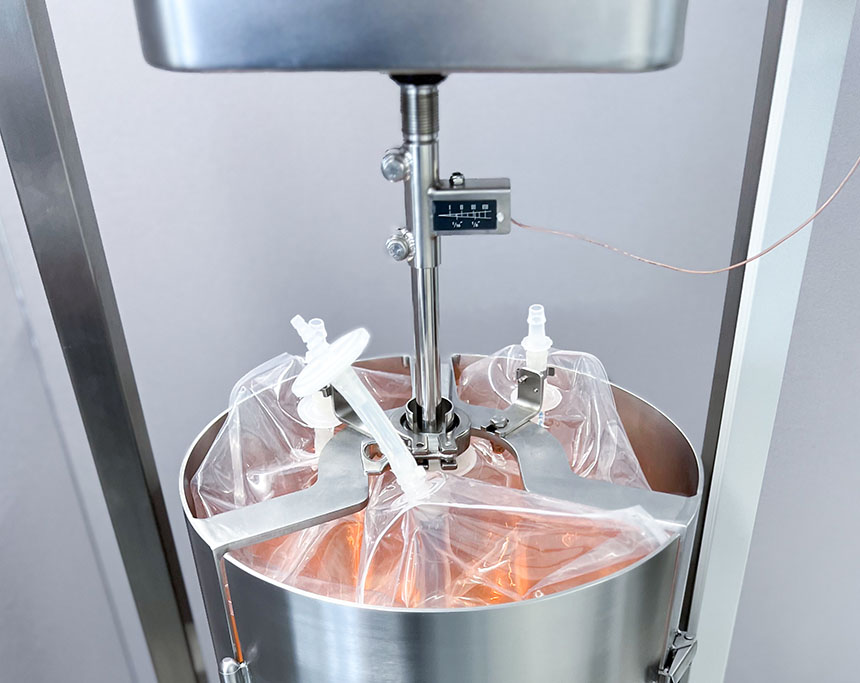
The principle has been used for decades in stainless-steel filter presses and candle filters. DrM’s FUNDALOOP® brings it into a fully automated, closed, single-use format. Alluvial filtration also uses DE, but builds the cake on a thicker medium inside a capsule that must be replaced once full.
| Parameter | Depth filtration | Alluvial filtration | Cyclical cake filtration |
|---|---|---|---|
| Filter medium | Thick depth medium | Depth medium, 2 to 4 mm | Thin cloth, ~0.5 mm |
| Where solids are captured | Inside the medium | In a DE cake on the medium | In a DE cake on the cloth |
| What limits capacity | Clogging of the medium | Cake volume per capsule | Cycles per bag (up to 50) |
| Regenerable | No | No | Yes, by backflush |
| Pre-flush required | Yes | Yes | No |
| Typical safety factor | 1.2 to 2.3× oversizing | Oversizing to avoid overfilling | Not needed; spare cycles provide margin |
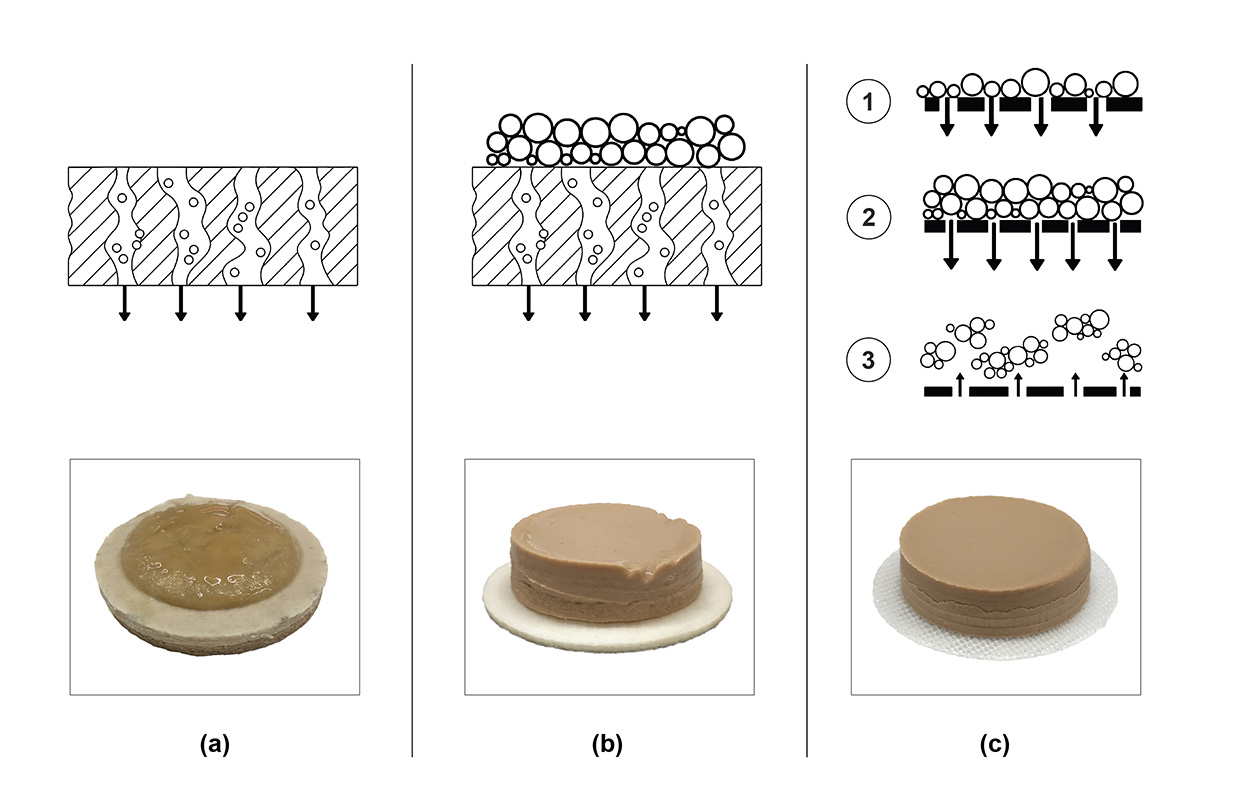
Where solids are captured in (a) depth, (b) alluvial and (c) cyclical cake filtration. In (c), the cake forms on a thin cloth (1), grows (2) and is backflushed off (3).
Why is harvest clarification becoming a bottleneck in biomanufacturing?
Clarification is the gateway to downstream processing, one of the most cost-intensive steps in bioproduction, so the quality of the feed it delivers shapes chromatography performance, product recovery and cost of goods. As upstream cell culture processes are optimized, conventional filters struggle to keep up during the harvesting step.
Depth filtration is used by 79% of manufacturers, according to BioPlan’s 2019 industry survey. Because its capacity is unpredictable with variable feeds, filter trains are routinely oversized by safety factors of 1.2 to 2.3. This helps protect batch integrity, but adds consumable cost, plastic waste and cleanroom footprint.
Why do depth filters clog during cell harvest?
Depth filters capture cells and debris inside the thick filter medium itself. As solids accumulate, a gel-like layer forms on top, flow falls and pressure rises until the filter blocks. High cell densities (above roughly 25 × 10⁶ cells/mL) make this worse.
In the ZHAW/DrM study, the depth filter became completely clogged after processing just 125 L/m² of fed-batch CHO culture. Under the same test conditions, neither the alluvial nor the cyclical cake filter experienced clogging.
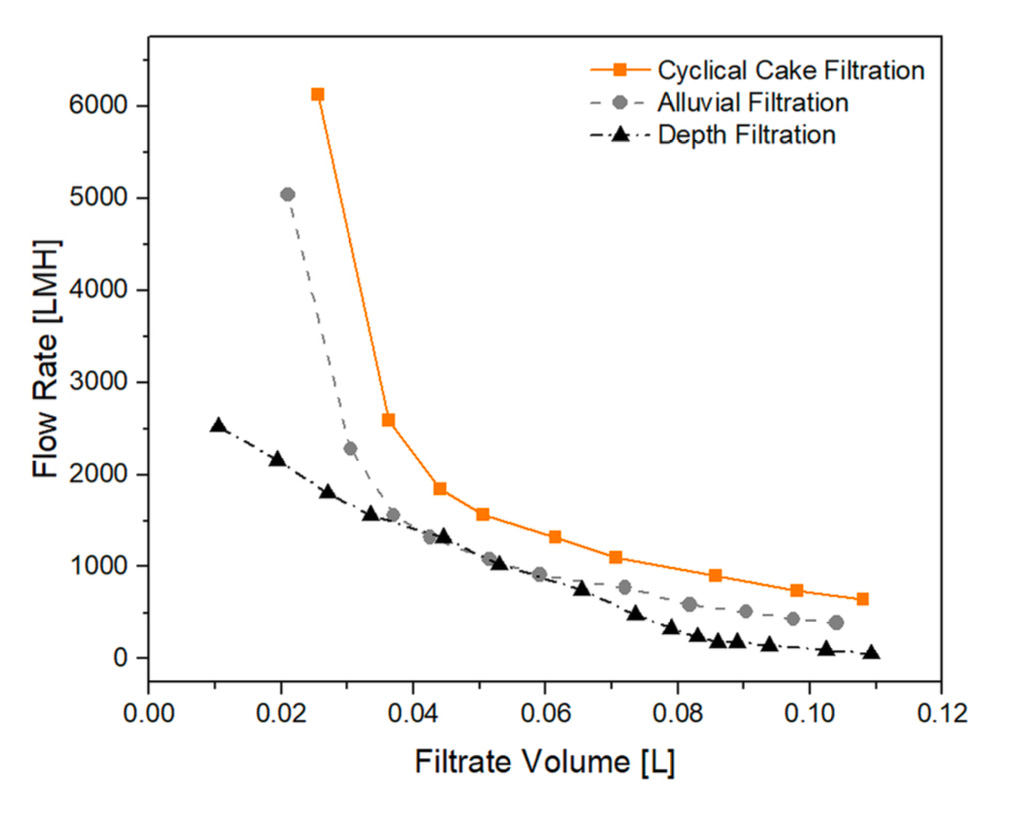
Flow rate over filtrate volume at a constant 1.5 bar. The depth filter clogged completely; cyclical cake filtration kept the highest flow rates.
What happens if a depth filter clogs mid-batch?
Operators face two bad options: stop early and lose product, or swap in a new filter and accept added contamination risk and downtime. Uneven flow and rising pressure can also push captured cells through the filter, causing turbidity breakthrough.
How does cyclical cake filtration avoid clogging?
The DE cake, not the filter medium, does the capturing, and the cloth is regenerated before the cake reaches its maximum volume. If a harvest is denser than expected, the system simply runs more cycles on the same equipment.
How did cyclical cake, alluvial and depth filtration compare in the study?
Cyclical cake filtration matched the primary-stage clarity of the alternatives while delivering higher product yield and far smaller filter area. The study used an IgG-expressing ExpiCHO-S cell line; yields will vary for other molecules.
| Result | Depth filtration | Alluvial filtration | Cyclical cake filtration |
|---|---|---|---|
| Clogging under test conditions | Yes | No | No |
| Primary filtrate turbidity (NTU) | 18.0 | 23.0 | 22.6 |
| Product yield before buffer wash | ~67% | ~80% | ~84 to 90% |
| Product yield after buffer wash | 84.1% | ~91% | 90.8 to 98.2% |
| Primary filter area for 2,000 L | 28.5 m² | 16.8 m² | 0.88 m² |
Cyclical cake yields are single-stage across four process conditions; depth and alluvial yields are after primary and secondary clarification.
When filter area and processing time were combined into a single efficiency measure, cyclical cake filtration scored best (122, versus 175 for alluvial and 214 for depth filtration; a lower value represents a more efficient solution). The depth and alluvial filters were standard commercial products used without optimization, and could potentially have performed better if optimized.
How much filter area do I need to clarify a 2,000 L bioreactor?
For primary clarification of 2,000 L of a fed-batch CHO culture at 8.5 million cells/mL and 75% viability, the study estimated that 28.5 m² of depth filter area, 16.8 m² of alluvial filter area, or just 0.88 m² of cyclical cake filter area was required. This represents a reduction in filter area of up to 96% compared with depth filtration and 94% compared with alluvial filtration.
The cyclical cake estimate uses two FUNDALOOP® 3000 bags processing 110 L per cycle. This would require 18 cycles and about 5.25 hours to complete, which is well within the bags’ 50-cycle rating. The depth and alluvial figures include a 50% safety factor. All figures are extrapolated from small-scale trials and assume consistent solids loading, so actual savings depend on your process.
Can I clarify a cell culture harvest in a single step?
Potentially. Adding an ion-exchange resin to the feed prior to cyclical cake filtration lets the filter cake capture DNA and host cell protein (HCP) as well as solids. With Daicel MabXPure, a single cyclical cake filtration step reduced DNA by 95% and HCP by 62% and brought turbidity to 2.8 NTU. That is comparable to two-stage alluvial filtration and approaches the 1.1 NTU that depth filtration reached after two stages.
Filtrate turbidity: cyclical cake filtration in one stage (four conditions) versus two-stage alluvial and depth filtration. C300 and S25E are diatomaceous earth grades; INDION 810 and MabXPure are ion-exchange resins.
Resin addition comes with a trade-off, though. The best-performing ratio added one part resin to ten parts feed, which is a substantial resin addition. Depending on the application, resin cost may offset the benefit of removing a filtration step. Each user should evaluate whether resin addition makes technical and economic sense for their own process.
Does cyclical cake filtration scale up from lab to commercial scale?
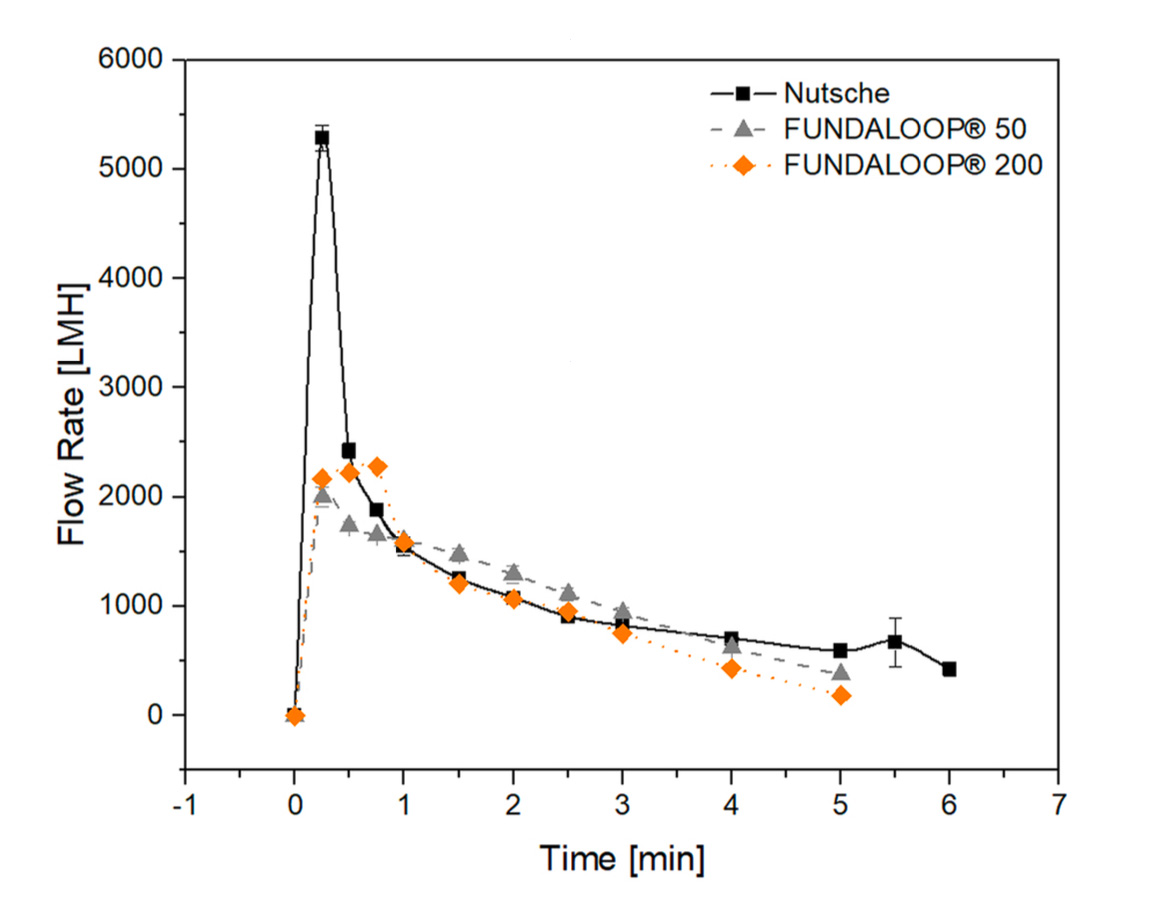
Yes. Flow rates and filtrate quality were consistent across three filter sizes, from a 0.001 m² lab-scale Nutsche to the 0.018 m² FUNDALOOP® 200, an 18-fold increase in filter area. Product yield ranged from 91.2% to 96.1% across scales.
Over 20 consecutive cycles on a FUNDALOOP® 50, flow rates declined gradually before leveling off, and turbidity stabilized about 30 seconds into each cycle, making cycle times predictable. DNA and HCP levels varied more between scales and warrant further study. The commercial-scale FUNDALOOP® 3000 was not tested, but shares the same operating principle and hydrodynamics. It has a filtration area of 0.44 m² and can process batch sizes of up to 2000 L.
How can I reduce single-use plastic waste in harvest clarification?
The most impactful way is to use less filter area. Every square meter of single-use filter adds consumable cost, extractables and leachables risk, plastic waste and cleanroom space. In this study, replacing roughly 28 m² of primary depth filters with two regenerable cyclical cake filter bags would substantially reduce the single-use material needed for primary clarification. The DE filter aid does add solids to the waste stream, so the net benefit depends on your waste handling.
Read the full study
https://link.springer.com/article/10.1007/s00253-026-14021-7
Key takeaways
- In a 2026 peer-reviewed study, cyclical cake filtration clarified CHO harvests without clogging under the tested conditions.
- Product yield after buffer wash reached 90.8 to 98.2%, compared with 84.1% for depth filtration.
- Estimated primary filter area for a 2,000 L batch was 0.88 m², versus 28.5 m² for depth filtration.
- Adding ion-exchange resin cut DNA by 95% and HCP by 62% in a single filtration step.
- Flow rates and filtrate quality stayed consistent across an 18-fold scale-up in filter area.