The extraction of natural gas requires the removal of suspended solids from the feed stream.
Generally, these streams can be grouped as follows:
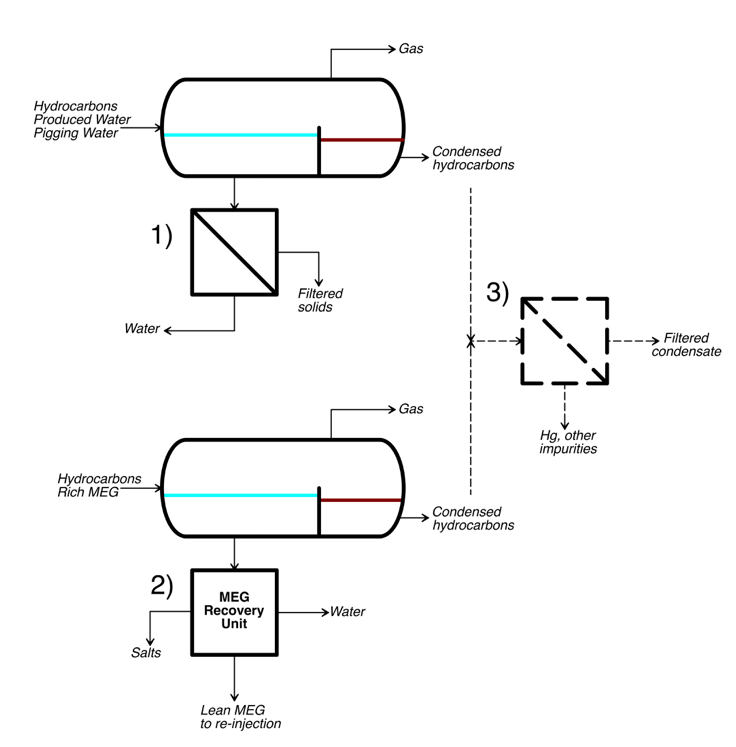
Produced Water (PW) and dirty liquid streams resulting from pipeline pigging operations
Rich monoethylene glycol (MEG) recycle streams which contain various salts from the produced water. The injection of MEG at the well head is the most common method to prevent formation of hydrates and avoid pipeline blockage. Hydrate inhibition is specifically requested when low temperatures are involved. Increased activities in offshore and deep sea drilling, where lower temperatures and longer pipelines to shore result in a significantly increased risk of hydrate formation, also triggered demand for MEG injection systems.
Hydrocarbon condensate which carry over solids from the slug catcher may also require further treatment.
The conventional FUNDABAC® filter is a sophisticated system capable of removing suspended solids down to 1 µm and smaller, is fully automatic and requires minimal operator intervention and maintenance expenditures.
The dry discharge capability of the FUNDABAC® filter allows for the disposal of a 50-70% dry cake and minimizes disposal requirements. Dangerous substances such as Hg, H2S and NORMs can be safely handled as a result of the fully enclosed design.
Filter aid can be used in situations where the process medium is difficult to filter, thus making FUNDABAC® filters suitable both for normal operation routines and for periodic, intermittent operations when solids generated by the system and their tendency to foul increase dramatically (e.g. pigging).
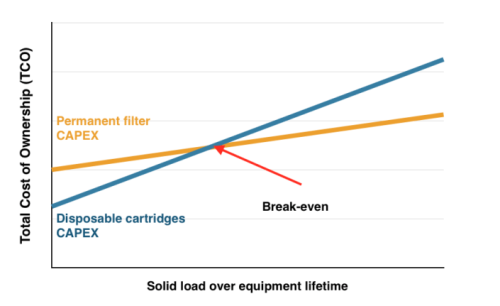 In some cases an automatic filter such as the FUNDABAC® may not be economically cost justifiable. Below a specific solid load, the OPEX of filter systems using disposable media (e.g. manual cartridge filters) may be desirable. This factor, coupled with a relative lower CAPEX, makes these systems more cost attractive.
In addition to being able to supply technically sophisticated FUNDABAC® filters, DrM also offers its customers cartridge type filters. DrM’s extensive know-how in solid-liquid separation processes puts DrM in the unique position to propose the most cost-effective filtration solution for a given set of application operating parameters. DrM’s recommendations always take both CAPEX and OPEX into account.
DrM is committed to the continuous development of its cartridge filter design and aims to minimize operator exposure to harmful substances, often an issue when disposable elements need to be replaced. Information about DrM’s cartridge elements and unique housing design can be found below or by contacting DrM.
DrM technical sales representatives are often asked to provide a rough cost impact study that compares its cartridge filters to its fully automatic FUNDABAC® filters. It is clear that due to design specifications and materials there is a broad range of variables impacting CAPEX. By creating sets of assumptions however, we can project figures that can give a general indication of CAPEX and OPEX, as per example on the next page.
Input figures and life time cost calculations for some cases
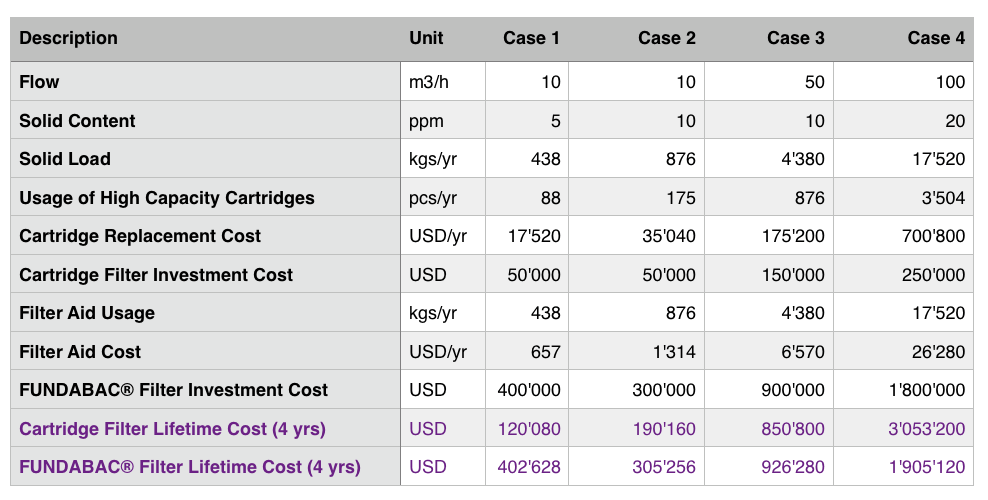
Please note that above figures do not take into consideration the disposal cost of either the solids cake discharged from a FUNDABAC® Filter or alternatively filter cartridges.
Operating costs are also not considered in the above comparative analysis. It should be assumed that both of those cost drivers will favour of the FUNDABAC® Filter due to its automation and lower solid waste production. Geographical location can influence these values significantly. Business operators will likely want to include those numbers in their own calculations.
As expected, the lifetime cost of a cartridge filter system is lower than that of a FUNDABAC® Filter in low solid loading applications (say, below 5’000 kgs/year) since the number of replacement cartridges is fairly proportional to the solid load.
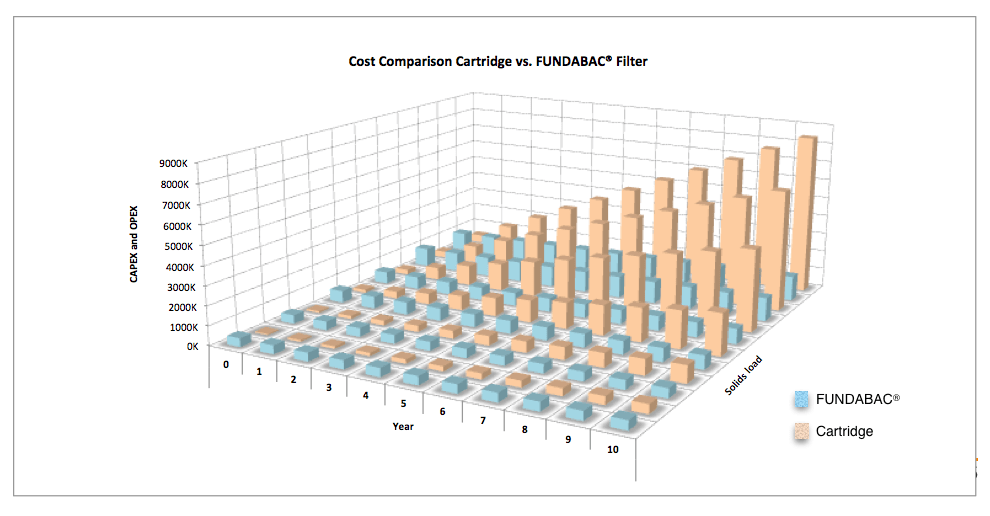
For higher flow and solids concentrations, the FUNDABAC® filter is more cost economical than cartridge filter systems. It should be noted that this analysis only takes CAPEX and OPEX into account. Other factors such as operator and environmental safety, proximity of disposal sites as well as physical space requirements may impact investment decisions.
Looking at past experiences in natural gas extraction plants, we can deduce that for removal of divalent salts from MEG that a FUNDABAC® Filter should be the best filter choice due to the higher solids load, despite the fact that liquid flows are not so high.
For produced water we need to view things differently. When considering both pigging and normal water treatment, a FUNDABAC® filter should be the equipment of choice. It can cope with fluctuating input solid loads and as well, higher concentrations are easily managed. For normal operation however, a cartridge filter system may be good choice.
For hydrocarbon condensate we normally deal with a low solid load and high liquid flows. The final consideration will therefore depend on the detail input data. Here the tendency is towards cartridge filters. However, the operator may also want to consider operator exposure to toxic chemicals and their disposal cost.
Conclusion
As can be seen in the above analysis, filter type selection is not as clear cut as it may first seem. To get a better understanding, input values can be applied to run a cost simulation model which will help in the decision making process. In this regard, DrM can provide valuable input.
Frequently Asked Questions
What streams in natural gas extraction require solids removal?
Solids removal in natural gas extraction is generally needed for three stream types: produced water (PW) and dirty liquid streams from pipeline pigging operations; rich monoethylene glycol (MEG) recycle streams, which carry salts from the produced water; and hydrocarbon condensate, which can carry over solids from the slug catcher.
Why is MEG injection used, and why does it need filtration?
Injecting MEG at the well head is the most common method to prevent hydrate formation and avoid pipeline blockage, particularly at low temperatures. Increased offshore and deep-sea drilling, with lower temperatures and longer pipelines to shore, has raised hydrate risk and demand for MEG injection systems. The resulting rich MEG recycle streams contain salts and solids that must be removed by filtration.
What makes the FUNDABAC® filter suitable for natural gas solids removal?
The FUNDABAC® removes suspended solids down to 1 µm and smaller, is fully automatic, and requires minimal operator intervention and maintenance. Its fully enclosed design allows dangerous substances such as mercury (Hg), H₂S and NORMs to be handled safely, and its dry-discharge capability produces a 50-70% dry cake that minimises disposal requirements. Filter aid can be used when the medium is difficult to filter or during intermittent operations such as pigging.
When is a cartridge filter more cost-effective than an automatic filter?
Below a certain solid load, an automatic filter such as the FUNDABAC® may not be economically justifiable. In these cases the lower OPEX of disposable-media systems like manual cartridge filters, combined with their relatively lower CAPEX, can make them more cost-attractive. DrM supplies both automatic and cartridge filters and recommends the most cost-effective option for the specific operating parameters.
How does DrM weigh CAPEX and OPEX when recommending a filtration solution?
DrM’s recommendations always take both CAPEX and OPEX into account. Because design specifications and materials create a broad range of variables affecting CAPEX, DrM builds sets of assumptions to project general CAPEX and OPEX figures and provide a rough cost-impact study comparing cartridge filters with fully automatic FUNDABAC® filters for a given application.