As industrial plants work to meet stricter water regulations and sustainability goals, Zero Liquid Discharge (ZLD) has become a key approach in modern wastewater management.
In a ZLD system, every drop of water leaving the process is recovered and reused. The remaining dissolved solids are crystallized and disposed of safely.
Achieving this goal depends heavily on how well the liquid–solid separation steps are designed. If upstream filtration is unreliable, evaporators and crystallizers downstream can become maintenance-intensive and energy-inefficient.
Why is pre-filtration critical in Zero Liquid Discharge systems?
Feed streams to ZLD units often contain suspended solids, metal hydroxides, or scaling particles from chemical treatment steps.
If these solids reach the thermal stage, they can cause fouling, unplanned shutdowns, and increased energy use. A robust filtration step between wastewater treatment and evaporation is therefore essential.
This is where DrM’s FUNDABAC® candle filter provides a proven solution.
How does the FUNDABAC® filter improve ZLD performance?
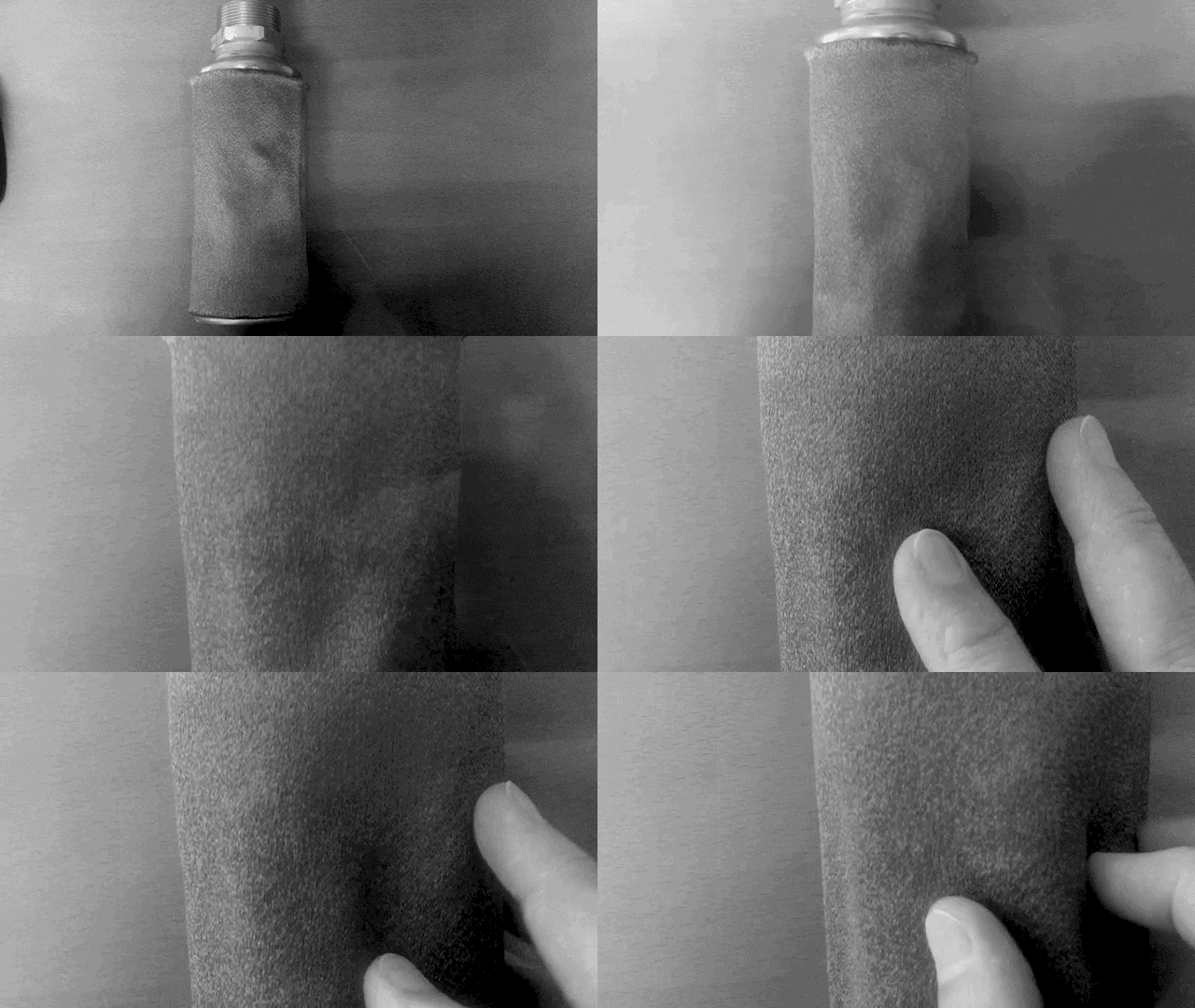
The FUNDABAC® system is a fully enclosed, automatic filter that separates solids from liquids using a cylindrical filter element design.
It performs reliably in high-salinity and corrosive wastewater environments, which are common in ZLD applications.
Key advantages
- Continuous and automated operation with minimal operator attention
- Dry or slurry discharge of solids, suitable for direct feed to dryers or crystallizers
- High-quality filtrate that helps minimize scaling in downstream evaporators
- Corrosion-resistant materials such as PVDF, PTFE, titanium, or rubber-lined steel
- Compact, closed design that prevents leakage and exposure
By efficiently removing fine suspended solids, the FUNDABAC® filter helps maintain the performance and uptime of evaporators and crystallizers, reducing manual maintenance effort and improving operational stability.


Where does filtration fit in a typical ZLD process?
A ZLD system usually includes:
- Chemical treatment and pH adjustment
- Pre-filtration with a FUNDABAC® system to remove suspended solids
- Evaporation and crystallization for concentration and solid recovery
In this chain, the pre-filtration step determines the stability of the entire system.
Selecting the right filter material and discharge configuration can have a major impact on uptime and energy use.
Our engineers design each system according to the feed composition and process layout, ensuring reliable separation before the thermal stage.
What results do plants see from FUNDABAC® in ZLD applications?
Across chemical, specialty, and metal-processing plants, FUNDABAC® filters are used for:
- Brine recovery before evaporators
- Concentrated wastewater polishing
- Metal-bearing effluents prior to crystallization
Operators report consistent filtrate clarity and stable long-term operation.
In numerous ZLD installations worldwide, DrM systems have demonstrated continuous service with only routine maintenance.
How does filtration support sustainability and circularity?
ZLD is more than compliance. It represents progress toward closed-loop water and resource management.
By improving the efficiency of separation and recovery, filtration turns wastewater from a liability into a usable resource stream.
Each cubic meter of water reused and each kilogram of material recovered contributes to a lower environmental footprint and higher process efficiency.
Why partner with DrM for ZLD filtration projects?
DrM has more than four decades of experience in automatic filtration systems.
With manufacturing and service centers in Switzerland, Poland, China and India, the company supports clients from design to commissioning and operation.
The FUNDABAC® system integrates easily into both new and retrofit ZLD projects, helping industries meet sustainability targets without compromising reliability.