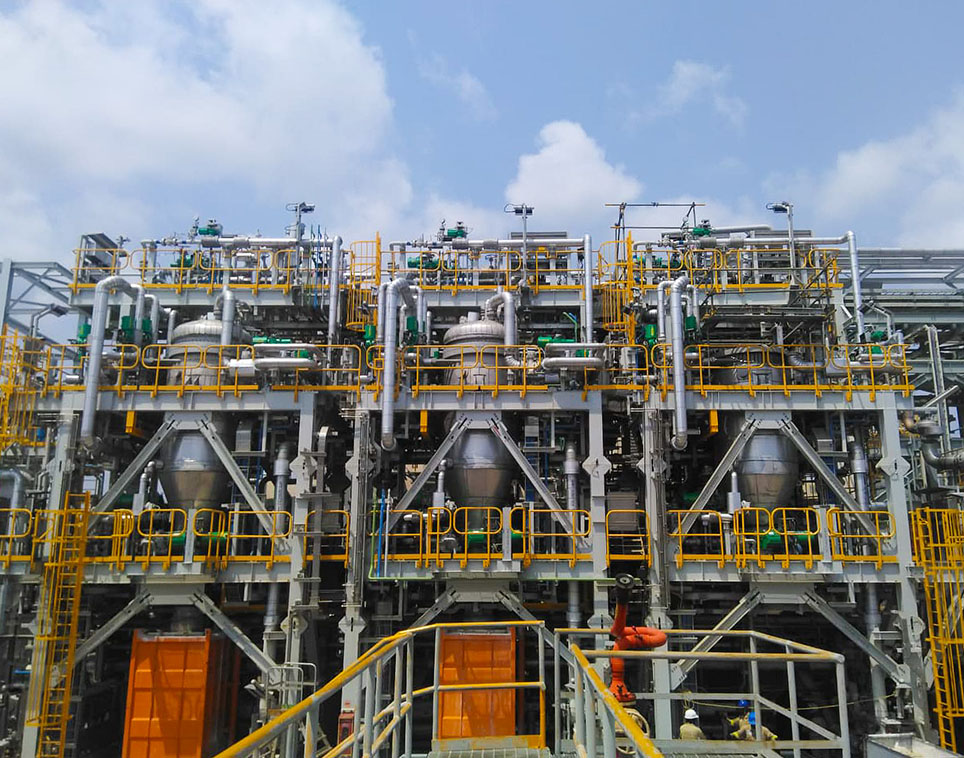
Amine gas sweetening is one of the most reliable acid gas removal processes in the industry. Operators have trusted alkanolamines like MEA, DEA, and MDEA to strip H2S and CO2 from sour gas streams for decades. The chemistry is well understood. The equipment is mature. And yet, foaming upsets, off-spec sweet gas, and accelerating corrosion continue to force unplanned shutdowns at plants around the world.
The common thread is almost always the same: suspended solids contamination in the circulating amine.
A clean amine solution will not foam, will not cause corrosion spikes, and will not foul column trays. The problem is fine iron sulfide particulate, predominantly below 10 microns, that accumulates continuously in the lean amine circuit. Once in suspension, these particles act as foam stabilizers, concentrating at gas-liquid interfaces in the absorber and regenerator, making foam bubbles harder to break, and driving the carryover, fouling, and corrosion events that follow. Left unmanaged, the contamination load grows faster than conventional cartridge filtration can handle.
What are the filtration requirements for a lean amine slip stream?
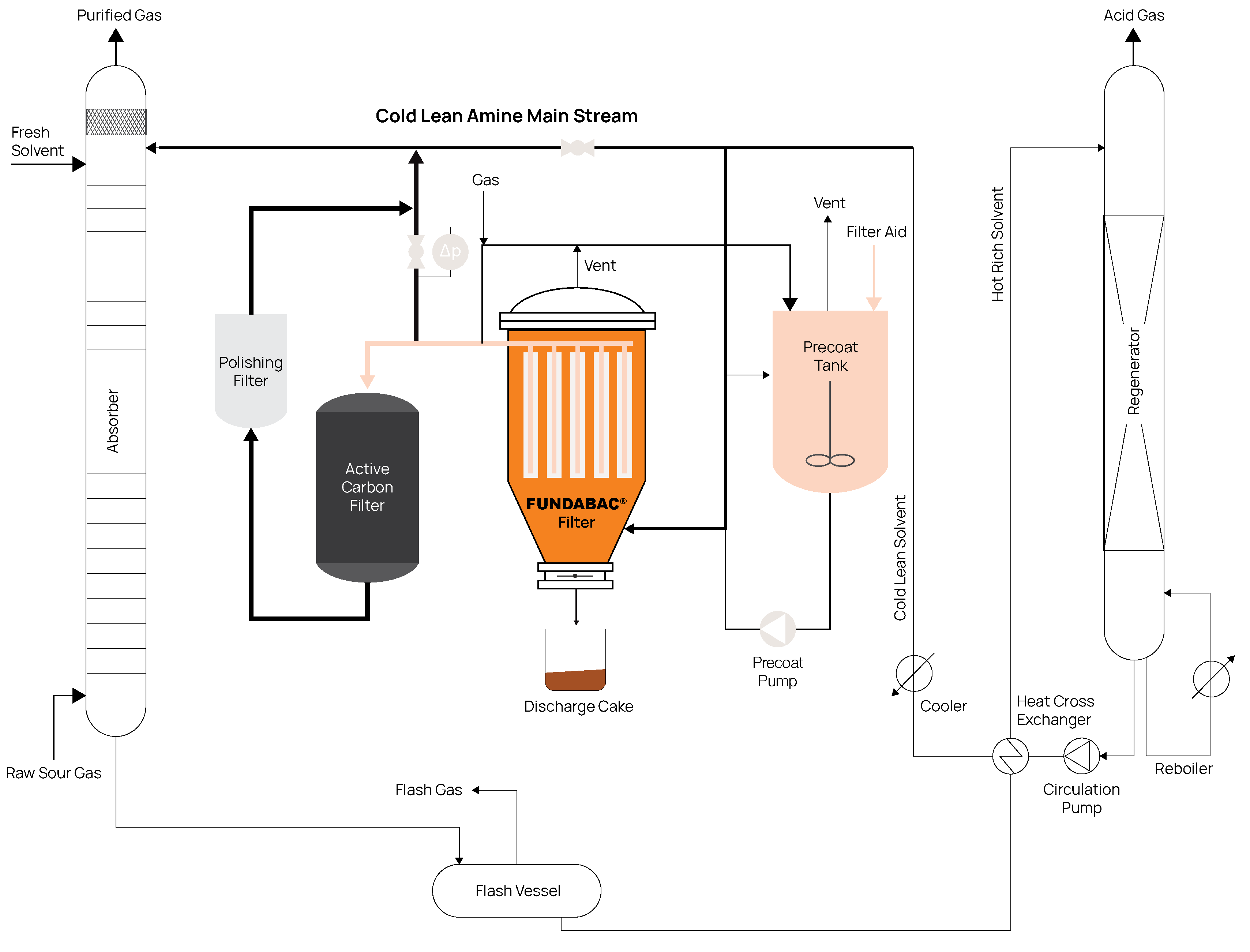
Industry practice is to filter a 10 to 20% slip stream taken from the lean side of the amine circuit, ahead of the absorber. The lean amine location is preferred because the solvent is cooler and at lower acid gas loading, which makes filtration more stable. The target is 1 micron absolute, sufficient to capture the fine iron sulfide particles responsible for foam stabilization. At world-scale gas treatment plants, slip stream flow rates can reach 100 to 600 m3/hr, which disqualifies batch or low-throughput equipment from consideration. Process compatibility with MEA, MDEA, DEA, and proprietary OASE-type formulations governs material selection for wetted components.
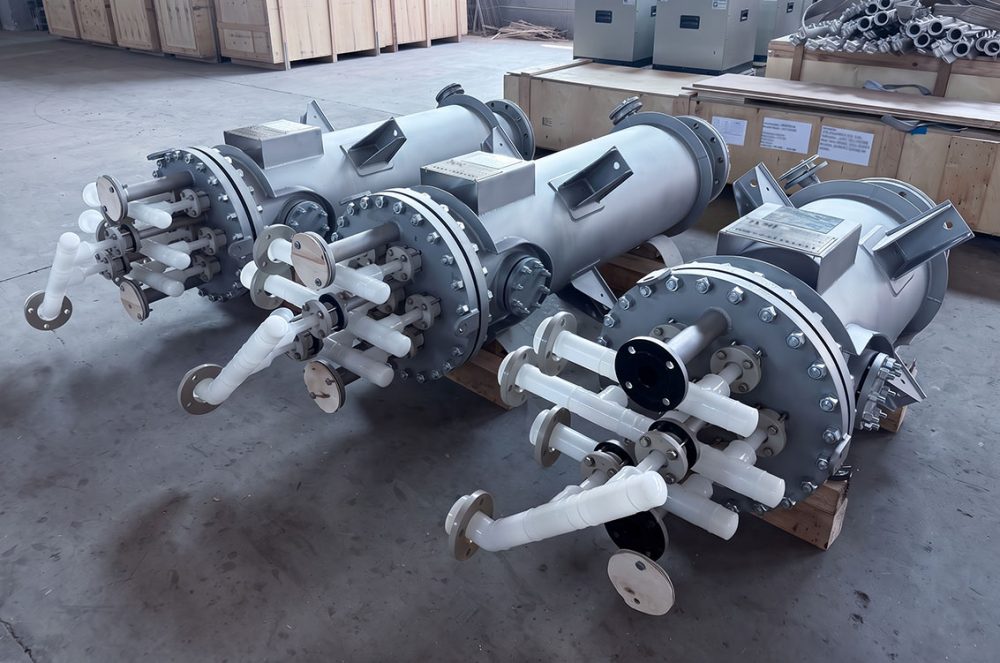
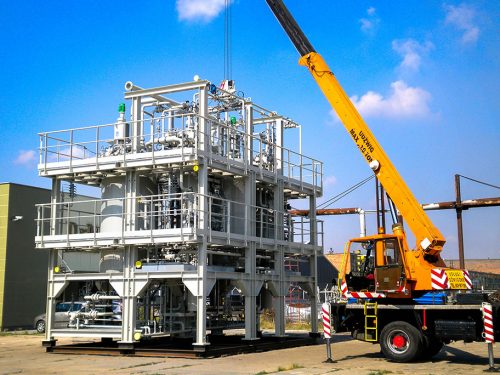
Particulate filtration alone is not sufficient for complete amine cleanup. The full system addresses all major contaminant classes in a skid-mounted package: a candle filter for iron sulfide and insoluble solids to 1 micron, a granular activated carbon adsorber for dissolved hydrocarbons and surface-active compounds, and a polishing cartridge filter to capture any carbon fines. The package integrates with plant PLC or DCS systems for fully automated operation.
How does a candle filter address the limitations of cartridge filtration in amine service?
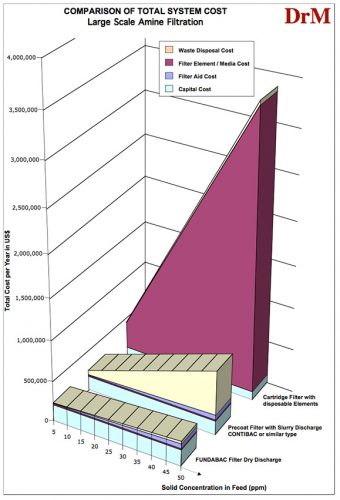
Replaceable cartridge filters perform adequately at smaller plant scales. At larger throughputs, the economics shift fundamentally. Elements loaded with iron sulfide require frequent replacement, sometimes within hours during upset conditions. Each changeout requires opening the filter vessel, exposing operators to H2S-laden amine solution, generating volumes of contaminated solid waste, and taking the filter offline. In remote or arid locations, logistics and disposal costs compound further. The structural problem is not just cost: filtration performance deteriorates progressively between changeouts, with the heaviest contamination passing through precisely when the element is most loaded.
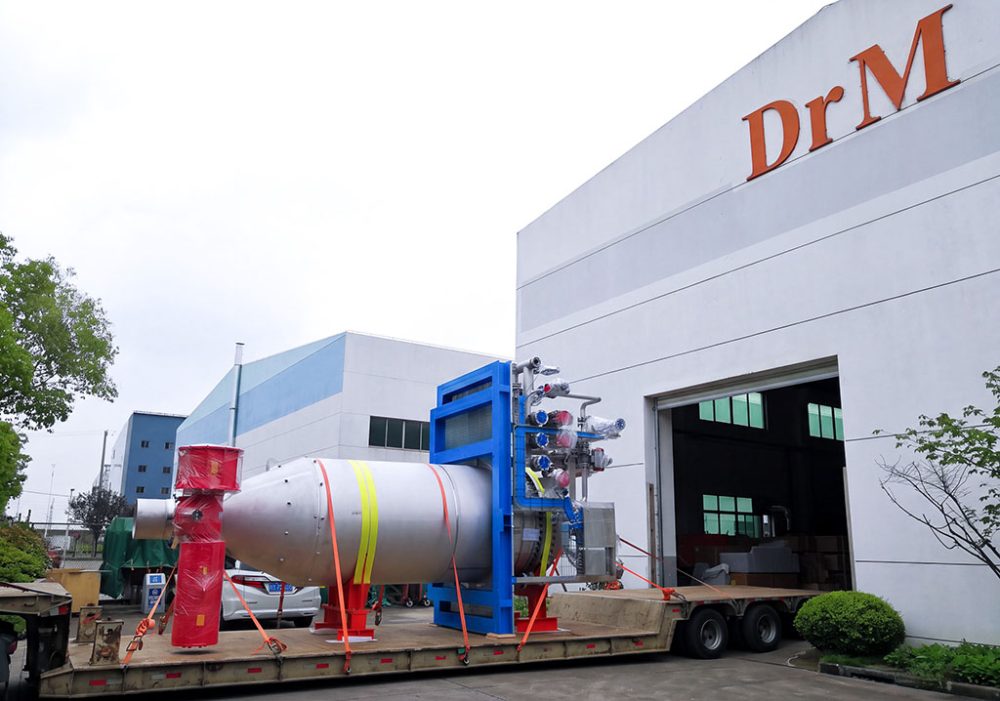
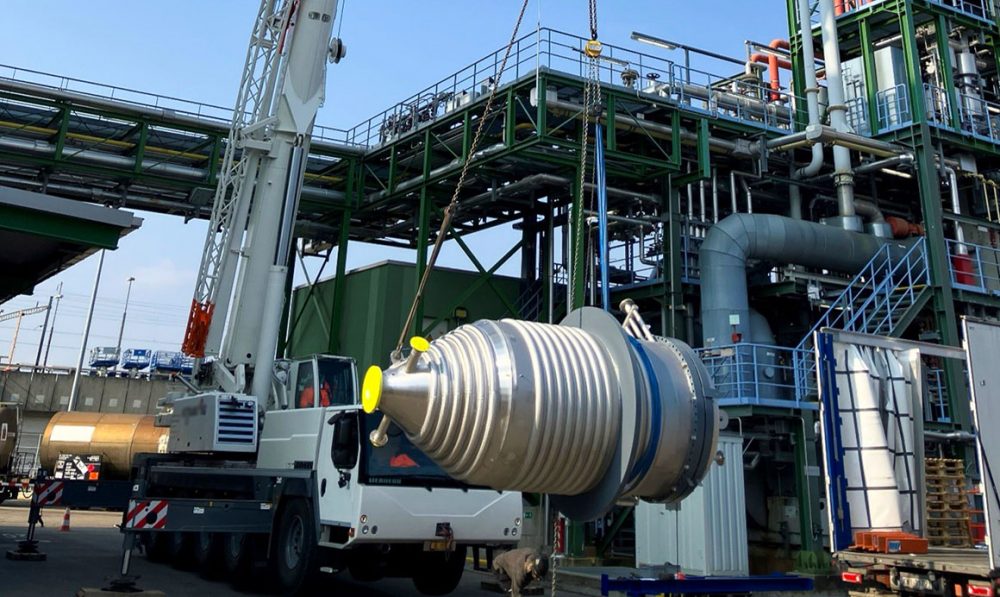
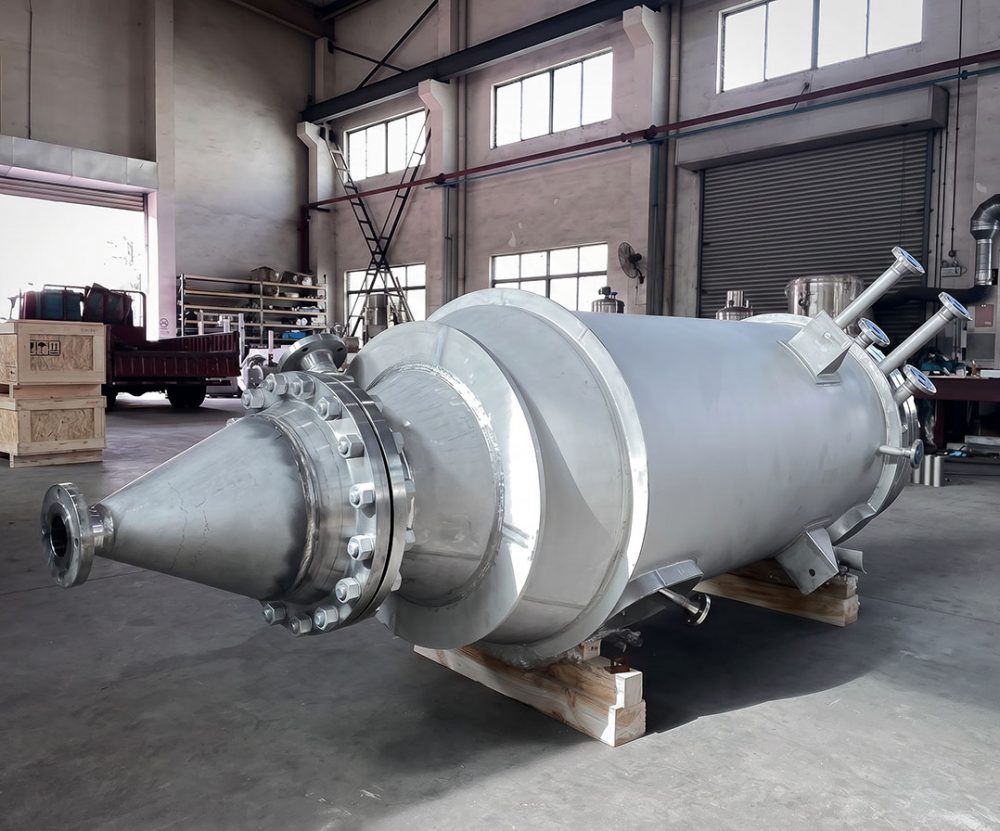
The FUNDABAC® candle filter operates as a pressure vessel in which the amine slip stream passes from outside to inside through vertical filter elements. Contaminants build up as a filter cake on the outer surface of the candles. When differential pressure reaches the set threshold, an automated gas blow-back cycle is initiated: a pressurized gas pulse reverses flow, lifting the filter media from the candle support structure and releasing the accumulated cake. The cake falls dry into the conical base and discharges through the bottom valve as a handleable solid. The filter vessel is never opened during normal operation; there is no operator exposure to amine solvent and no generation of liquid hazardous waste.
Key operational parameters in amine service
- Filtration rating: 1 micron absolute with filter aid precoat, sufficient to capture fine iron sulfide particles.
- Demonstrated performance: suspended solids reduced from feed concentrations of 16 to 42 mg/L to below 1 mg/L in the filtrate after 15 hours of operation.
- Filtration cycle time: typically two weeks, depending on solids loading.
- Regeneration time: approximately 45 minutes per cycle.
- Filter cloth replacement: every two to five years during scheduled shutdowns.
- Operator exposure during normal operation: none; the vessel is never opened.
The filter aid precoat is prepared in amine make-up solution rather than water, eliminating the need for demineralized water in water-scarce locations. Standard precoat filters that discharge as a slurry can lose 5,000 liters or more of amine solution per filtration cycle in addition to waste requiring secondary treatment. The dry cake from a FUNDABAC® filter contains approximately 30 to 40% residual moisture and exits as a non-dusting solid suitable for direct landfill or incineration disposal, with no secondary stage required.
Candle filter vs. cartridge filter: operational comparison
| Parameter | Cartridge filter | FUNDABAC® candle filter |
|---|---|---|
| Primary role in amine service | Polishing or guard filtration for lean or rich amine | Continuous enclosed solids removal for higher-solids or larger-throughput amine loops |
| Filtration rating | Depends on element specification; absolute rating should be confirmed for the duty | 1 micron absolute with filter aid precoat, sufficient to capture fine iron sulfide particles |
| Suitability for upset loading | Less tolerant of sudden solids spikes; may require earlier changeout | More tolerant because of cyclic operation and automated solids handling |
| Maintenance impact | More frequent manual element replacement | Lower operator intervention; cloth replacement at scheduled shutdowns every 2 to 5 years |
| Operator exposure | Higher during cartridge changeout | Lower because operation is enclosed |
| Waste handling | Spent cartridges become contaminated solid waste | Solids discharged as dry cake for controlled removal; no secondary treatment required |
When cartridge filtration still makes sense
Cartridge filters remain the right choice for smaller amine units where throughputs are low, solids loading is modest, and changeout frequency is manageable. They also serve well as polishing or guard filters downstream of a candle filter stage, as in the three-stage configuration described above. The economics argument against cartridge filtration applies specifically at scale: high-throughput plants with variable contamination loads, remote locations with disposal constraints, or applications where unplanned maintenance shutdowns carry significant operational cost.
What discharge configuration suits installations where dry cake is not preferred?
Not every amine gas sweetening installation requires dry cake discharge. Where downstream handling infrastructure favors a pump-able waste stream, or where solid cake volumes are small, the CONTIBAC® semi-continuous thickener provides slurry discharge within the same candle filter architecture. The CONTIBAC® operates with back-flush using gas or filtrate rather than full dry discharge, and suits applications where a concentrated slurry can be transferred directly to a downstream treatment step. Both configurations support PLC or DCS integration for fully automatic operation, and both eliminate the manual handling and hazardous waste volumes associated with cartridge replacement. The choice between dry cake and slurry discharge is driven by site-specific waste handling infrastructure and disposal requirements, not by filtration performance.
Why does filtration quality matter in amine-based carbon capture applications?
The same amine chemistry used for sour gas sweetening is the basis for post-combustion carbon capture in power plants, cement factories, and other industrial facilities. MEA and proprietary amine blends are central to the CCUS buildout, and the contamination dynamics in capture loops are in several respects more demanding than in traditional gas treating applications. Flue gas from combustion sources contains fine solids carryover as well as oxygen, NOx, and SO2 in addition to CO2. Oxygen drives oxidative degradation reactions that generate heat-stable salts and other byproducts at accelerated rates, reducing the cyclic CO2 loading capacity of the solvent and increasing the frequency of reclaiming operations. Any increase in contamination that forces higher reboiler duty or reduced capture efficiency directly affects the energy performance and economics of the capture process. For CCUS project developers and EPC contractors specifying filtration at the design stage, solvent quality is a project economics decision. The FUNDABAC® enclosed, automated design is well suited to the rigorous operational standards that carbon capture projects require.
Reference base and experience in amine gas sweetening service
DrM has supplied candle filter systems into amine gas sweetening service for nearly four decades, with installations across the Middle East, North Africa, Southeast Asia, and Europe covering plant scales from mid-size gas processing units to world-scale facilities processing combined lean amine flows up to 1,000 m3/hr across parallel filter units. As new gas treatment capacity is developed for increasingly sour feed streams and tighter sales gas specifications, and as amine-based carbon capture projects move from pilot to industrial scale, the operating cost case for automated candle filtration continues to strengthen.
Key takeaways
- Fine iron sulfide particulate, predominantly below 10 microns, is the primary driver of foam stabilization in circulating amine systems and the root cause of the foaming, fouling, and corrosion cascade that follows.
- Candle filtration of a 10 to 20% lean amine slip stream to 1 micron absolute is established industry practice for controlling suspended solids in gas sweetening units.
- The FUNDABAC® filter reduces suspended solids from feed concentrations above 40 mg/L to below 1 mg/L in the filtrate, with automated dry cake discharge and no operator exposure during normal operation.
- Filter cloth replacement occurs every two to five years during scheduled shutdowns, compared to the frequent changeouts required by cartridge systems at comparable throughputs.
- Cartridge filters remain appropriate for smaller amine units and polishing duties downstream of a candle filter stage.
- The same filtration requirements apply in amine-based post-combustion carbon capture, including cement and power generation, where solvent degradation directly affects capture efficiency and project economics.
- For installations preferring a pump-able waste stream, the CONTIBAC® semi-continuous thickener provides slurry discharge within the same candle filter architecture.
Frequently Asked Questions
What causes foaming in amine gas sweetening units?
The primary cause is fine iron sulfide particulate, predominantly below 10 microns, that accumulates in the circulating amine. Once in suspension, these particles act as foam stabilizers, concentrating at gas-liquid interfaces in the absorber and regenerator, which makes foam bubbles harder to break and drives the carryover, fouling, and corrosion that follow. A clean amine solution will not foam, cause corrosion spikes, or foul column trays.
What filtration rating is required for amine gas sweetening?
Industry practice is to filter a 10 to 20% slip stream taken from the lean side of the amine circuit, ahead of the absorber, to 1 micron absolute. That rating is sufficient to capture the fine iron sulfide particles responsible for foam stabilization. The lean amine location is preferred because the solvent is cooler and at lower acid gas loading, which makes filtration more stable.
How does a FUNDABAC® candle filter differ from a cartridge filter in amine service?
A FUNDABAC® candle filter is an enclosed pressure vessel where contaminants build up as a cake on vertical filter elements and are removed by an automated gas blow-back cycle, discharging as a dry, handleable solid without ever opening the vessel. Cartridge filters must be opened for frequent manual element changeouts, exposing operators to H2S-laden amine and generating contaminated solid waste. At high throughputs the candle filter’s continuous, automated operation is far more economical.
Does candle filtration lose amine solution during operation?
Very little. The filter aid precoat is prepared in amine make-up solution rather than water, and the dry cake discharged from a FUNDABAC® filter contains only about 30 to 40% residual moisture, exiting as a non-dusting solid. By contrast, standard precoat filters that discharge as a slurry can lose 5,000 liters or more of amine solution per filtration cycle, plus waste requiring secondary treatment.
Why does amine filtration matter for carbon capture?
Post-combustion carbon capture uses the same MEA and proprietary amine blends as sour gas sweetening, but the contamination is more demanding: flue gas carries fine solids plus oxygen, NOx, and SO2. Oxygen drives oxidative degradation that generates heat-stable salts, reducing the solvent’s CO2 loading capacity and increasing reclaiming frequency. Any contamination that raises reboiler duty or lowers capture efficiency directly affects the energy performance and economics of the capture process.
When is a cartridge filter still the right choice for amine service?
Cartridge filters remain appropriate for smaller amine units where throughputs are low, solids loading is modest, and changeout frequency is manageable, and as polishing or guard filters downstream of a candle filter stage. The economic case for candle filtration applies specifically at scale: high-throughput plants with variable contamination loads, remote locations with disposal constraints, or applications where unplanned maintenance shutdowns carry significant operational cost.