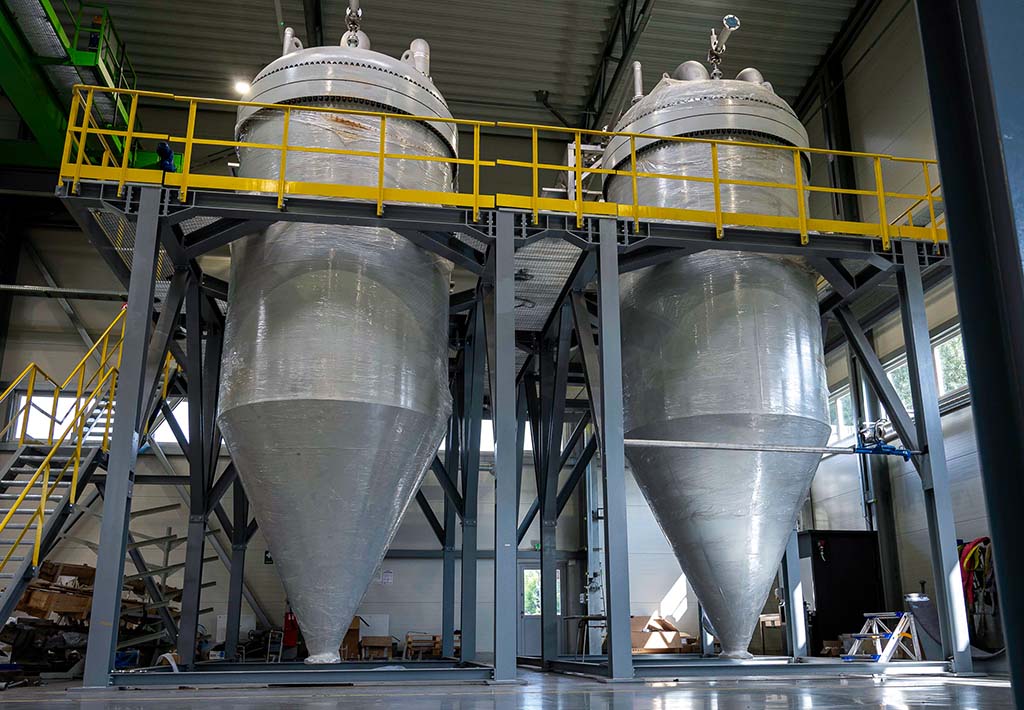
Carbon capture solvent picks up solids and degrades faster than solvent in natural gas treating, because flue gas carries oxygen, NOx, SO₂, and dust into the absorber along with the CO₂. Controlling those solids with an enclosed candle filter on the lean solvent loop reduces reclaiming frequency, reboiler duty, and solvent make-up cost.
What contaminates the solvent in a carbon capture plant?
Capture solvent is contaminated by what the flue gas carries in and by what the solvent produces as it degrades. Flue gas brings fine solids, such as fly ash from coal-fired boilers, kiln dust from cement plants, and carryover from flue gas desulfurization, together with oxygen, NOx, and residual SO₂. Cement kiln flue gas is among the hardest capture feeds: its dust loading is higher than a power plant’s and varies with raw meal and fuel.
Oxygen drives oxidative degradation of the amine, while SO₂ and NOx form heat-stable salts. Degradation makes the solvent more corrosive, and corrosion adds fine particulate to the loop.
These contaminants are handled in two ways. Heat-stable salts and most degradation products are dissolved and removed by reclaiming. Filtration removes the suspended solids: dust, corrosion products, and precipitates. Because suspended solids stabilize foam, foul heat exchangers and packing, and contribute to corrosion, a loop with poor solids control needs reclaiming more often.
How does solvent contamination affect capture efficiency and energy use?
Contamination raises energy use, disrupts operation, and increases solvent consumption. As degradation products and heat-stable salts accumulate, cyclic loading capacity falls, and the plant must circulate more solvent or regenerate it harder to hold the capture rate. Reboiler duty rises, and reboiler steam is one of the largest operating costs in amine-based capture. Suspended solids add foaming in the absorber and stripper and fouling of the lean/rich heat exchanger, which cut throughput or force unplanned shutdowns.
Every reclaiming campaign and filter changeout also removes solvent from the loop. Newer, degradation-resistant solvent blends cost more than conventional MEA, so how a filter discharges its solids matters as much as what it retains.
Which filters are used for amine scrubbing and carbon capture?
Capture plants use three filter types on a slip stream of the lean solvent: cartridge filters, precoat candle filters with dry cake discharge, and back-washable candle filters with slurry discharge. These are often followed by an activated carbon bed and a polishing stage.
Cartridge filters suit small units and polishing duties. At capture scale, with dust in the flue gas, elements load quickly, each changeout means opening a vessel of degraded solvent, and every spent element becomes contaminated waste.
The FUNDABAC® candle filter is built for high-dust streams such as coal-fired boiler and cement kiln flue gas, and for DAC. Solids build up as a cake on vertical filter candles, and at a set differential pressure a gas blow-back cycle discharges the cake dry through the bottom valve. Precoat and body feed absorb variable, high solids loadings, and patented heel volume filtration minimizes the solvent left in the vessel.
The CONTIBAC® candle filter is built for uninterrupted processing in large-scale DAC and continuous post-combustion loops. Its elements are backwashed in place with gas or filtrate, and continuous solids discharge keeps solvent processing uninterrupted, even during regeneration cycles. Solids leave as a concentrated slurry, which keeps solvent loss low.
Both are fully enclosed pressure vessels with PLC or DCS control and are not opened during normal operation, so operators do not handle degraded solvent or spent elements. The same architecture is well established in natural gas treating, covered in our article on amine gas sweetening filtration.
| Parameter | FUNDABAC® Candle Filter | CONTIBAC® Candle Filter |
|---|---|---|
| Best suited for | High-dust streams, high solids purity | Continuous clarification and thickening |
| Operation mode | Batch / semi-continuous | Continuous / semi-continuous |
| Filter media | Precoat and body feed, synthetic fibers | Back-washable elements, regenerated in place |
| Cake washing | Yes, with reduced solvent and wash liquid loss | Not applicable |
| Solvent loss | Minimized by patented heel volume filtration | Minimized by concentrated slurry discharge |
| Solids discharge | Dry cake | Concentrated slurry |
| Maintenance | Media replaced every 1 to 3 years in high-dust capture service | Back-washable elements extend filter life |
The choice usually comes down to the site. Dry cake suits plants that send solids to landfill or incineration, while slurry discharge suits plants that can pass a concentrated stream to downstream treatment.


How is filtration different in direct air capture?
In DAC, solvent recovery drives cost per tonne. DAC systems circulate large solvent volumes relative to the CO₂ they recover, and instead of flue gas dust, the loop accumulates precipitated salts, degradation products, and fine particulate at low concentrations. The filter has to clarify dilute streams over long campaigns with minimal intervention. DrM has supplied CONTIBAC® filters for direct air capture in the United States, removing precipitated solids from the solvent circuit.
Scaling carbon capture with proven solids control
More than 80 DrM filters are in operation in gas sweetening and carbon capture across Europe, the Middle East, North Africa, Asia, and North America, from pilot plants to commercial-scale DAC. As capture moves into cement, steel, and waste-to-energy, flue gases get dustier and solvents more expensive, making solids control a design-stage decision. Pilot and lab-scale units allow a separation to be tested on a plant’s own solvent before full-scale investment.
Key takeaways
- Flue gas carries oxygen, NOx, SO₂, and dust into the absorber, so capture solvent degrades faster than gas treating solvent.
- Cement kiln flue gas is among the hardest capture feeds because of its high and variable dust loading.
- Reclaiming removes dissolved heat-stable salts. Filtration removes the suspended solids that drive foaming, fouling, and corrosion.
- The FUNDABAC® candle filter suits high-dust streams: it has precoat and body feed, dry cake discharge, and media replaced every 1 to 3 years.
- The CONTIBAC® candle filter suits continuous loops and DAC: it has in-place backwashing and concentrated slurry discharge.
- More than 80 DrM filters are in operation in gas sweetening and carbon capture across five regions.
Frequently Asked Questions
Does filtration remove heat-stable salts from carbon capture solvent?
No. Heat-stable salts are dissolved and are removed by reclaiming or other solvent purification steps. Filtration removes suspended solids such as flue gas dust, corrosion products, and precipitates. Good solids control reduces how often reclaiming is needed, but it does not replace it.
Is candle filtration suitable for carbon capture at cement plants?
Yes. Cement kiln flue gas carries more dust than most power plant flue gas, and its loading varies with raw meal and fuel, so the solvent filter must tolerate high, fluctuating solids. Precoat and body feed candle filtration is designed for this duty, and dry cake discharge keeps the removed dust out of the solvent loop without generating spent cartridges.
What materials are candle filters for carbon capture built from?
Vessels are available in carbon steel, stainless steel grades, titanium, high nickel alloys, and fiberglass, with lining options including hard rubber, PVDF, PFA, ECTFE, and enamel. Filter media options include PP, PVDF, PTFE, PPS, PEEK, PE, UHMWPE, and SS 316L, selected to match the solvent and operating temperature.
Can a filter be tested on our own solvent before purchase?
Yes. DrM offers pilot and lab-scale FUNDABAC® and CONTIBAC® units for on-site or off-site testing under real process conditions, so performance can be confirmed on a plant’s actual solvent before a full-scale investment.