Demand outlook
Lithium is at the heart of the energy transition. From electric vehicles to grid-scale storage, the demand for high-purity lithium compounds is soaring.
Current estimates suggest demand in 2025 is around 1.4 to 1.5 million tonnes LCE, already straining supply chains. Looking ahead, analysts forecast demand could more than double to 3.7 million tonnes by 2030, with some scenarios pointing to 3.5 times growth by 2030 and up to 6.5 times by 2034 compared with 2023 levels.
This steep growth puts enormous pressure on lithium producers to scale up capacity, improve recovery, and maintain product purity.
Key challenges in lithium production
- Impurities: Lithium brines and spodumene leach solutions contain high levels of Mg, Ca, Mn, Zn and other salts that must be removed.
- Scaling and fouling: Precipitated solids can clog equipment and reduce uptime.
- High volumes: Large-scale operations demand robust, automated systems with minimal downtime.
- Product losses: Inefficient separation can waste valuable lithium during processing.

Where FUNDABAC® and CONTIBAC® Filters come in
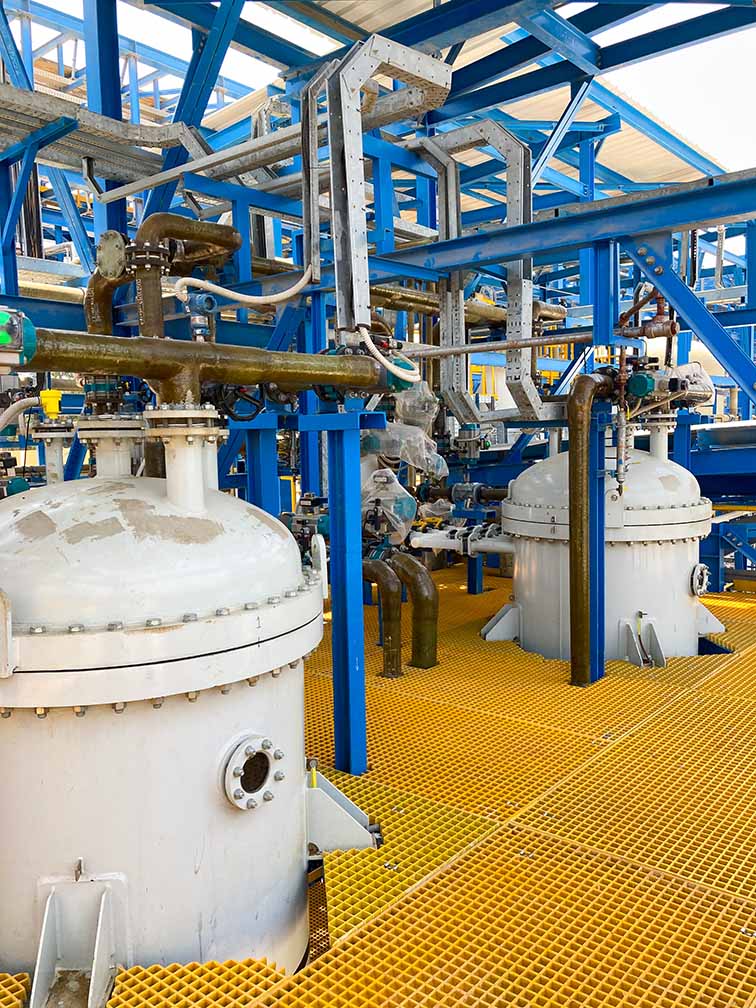
DrM’s candle filter systems are used worldwide in lithium carbonate and hydroxide plants, with over 100 references across five continents. These include projects in Australia, South America, North America and Asia, with clients ranging from established producers to new large-scale entrants.
Our filters support multiple steps of the process flow sheet:
- Purification of lithium sulphate solutions: FUNDABAC® removes more than 99.9% of solids ≥1 µm, protecting sensitive downstream equipment like ion exchange and reverse osmosis.
- Polishing and guard filtration: Ensures stable operation in lithium carbonate and hydroxide production lines.
- Bicarbonate polishing circuits: Removes unreacted solids to maximize lithium carbonate purity.
- Spodumene and brine projects: From hard rock operations in Australia to brine-based production in South America, FUNDABAC® and CONTIBAC® have proven their ability to handle scaling-prone suspensions while maintaining stable cycle times.
- Semi-continuous operations: CONTIBAC® filters handle high flow rates with automated cake discharge, minimizing operator intervention and reducing operating costs.
Proven reliability at scale
Experience shows that efficiency in lithium production is not only about chemistry, but also about mechanical reliability. DrM filters are designed to reduce lithium losses through effective cake washing and drying, ensuring recovery of valuable product. With more than a hundred installations already in operation, our technology has demonstrated long-term performance in diverse conditions and geologies.
Common client questions:
- Can DrM filters handle scaling solids?
Yes, they are designed for scaling-prone suspensions and maintain stable cycle times. - Do they reduce lithium losses?
Yes, cake washing and drying cut losses to negligible amounts. - Are they proven at scale?
Yes, with more than 100 installations worldwide, including projects in Australia, Chile, Argentina, Canada and China.


The bigger picture
As battery makers increasingly shift toward lithium hydroxide for higher energy density, producers face growing demands for purity, efficiency and scalability. Filtration may not be the headline step in lithium production, but it is the backbone that ensures consistent quality and reliable output.
At DrM, we are proud to contribute to this transformation. Our FUNDABAC® and CONTIBAC® filtration systems help lithium producers worldwide achieve the reliability, scalability and sustainability required to power the energy transition.
Frequently Asked Questions
What are the key filtration challenges in lithium production?
Lithium brines and spodumene leach solutions contain high levels of Mg, Ca, Mn, Zn and other salts that must be removed. Precipitated solids can cause scaling and fouling, clogging equipment and reducing uptime. Large-scale operations demand robust, automated systems with minimal downtime, and inefficient separation can waste valuable lithium during processing.
Where in the lithium production process are FUNDABAC® and CONTIBAC® filters used?
DrM’s filters support multiple steps of the lithium process flowsheet. The FUNDABAC® removes more than 99.9% of solids of 1 micron and above from lithium sulphate solutions, protecting sensitive downstream equipment such as ion exchange and reverse osmosis systems. It is also used in polishing and guard filtration, bicarbonate polishing circuits to maximize lithium carbonate purity, and in both hard rock spodumene operations and brine-based production. The CONTIBAC® handles high flow rates with automated cake discharge for semi-continuous operations.
Can DrM filters handle the scaling-prone suspensions common in lithium processing?
Yes. Both the FUNDABAC® and CONTIBAC® are specifically designed for scaling-prone suspensions and maintain stable cycle times. Across projects in Australia, South America, North America and Asia, these filters have demonstrated reliable performance in diverse conditions and geologies, with more than 100 installations in lithium carbonate and hydroxide plants worldwide.
How do DrM filters reduce lithium product losses during filtration?
DrM filters minimize lithium losses through effective cake washing and drying, which cut losses to negligible amounts. Patented heel volume filtration further ensures that residual product at the bottom of the vessel is fully recovered rather than lost, directly improving overall yield and reducing waste in lithium production.
Why is filtration critical to meeting growing lithium demand?
Demand for high-purity lithium compounds is forecast to more than double by 2030, putting enormous pressure on producers to scale up capacity, improve recovery, and maintain product purity. Filtration may not be the headline step in lithium production, but it is the backbone that ensures consistent quality and reliable output, making it essential for the industry’s ability to meet the demands of the energy transition.