The challenges of current recycling processes
As environmental awareness from people, companies and governments has increased over the last few decades, noticeable efforts are being made in order to bring recycling processes of plastics or synthetic textiles to commercial scale.
A number of recycling technologies are under investigation, each with certain complexities and peculiar performances, but the ultimate goal of all of these is to economically manufacture cloths or other objects from recycled polymers rather than from virgin oil feedstock.
Purely mechanical processes, involving crushing/shredding of end-of-life objects before melting them into granules represent an older approach and are not capable of removing impurities chemically bound in the original structure of the recycled object; a typical example is constituted by pigments, dyes or other substances used to colour or to otherwise modify the properties of the original object. Plastics recycled this way have therefore restricted use, limited to products of inferior quality.

Achieving plastics of a cleaner grade
In order to achieve plastics of a cleaner grade, comparable to what is produced by petrochemical processes and therefore with an identically wide range of application, recycling operations must include a purification step. These newer processes are more technology-intensive as they typically involve the depolymerisation of the plastic into the constituting monomers or its dissolution into specific solvents. When dissolution methods are applied, the molten plastic and the solvent are found as a single, homogeneous liquid phase and the molecular structure of the polymer (e.g. PP, PET) is kept. Impurities remain in suspension and can be removed by means of solid-liquid separation techniques.

A fundamental issue is represented by the fact that the above mentioned dissolution processes are typically carried out under harsh conditions: high temperatures, high pressure, chemically aggressive or otherwise hazardous solvents can be present, even in combination. As a result, the selection of the equipment to be used for the solid-liquid separation is significantly restricted to very few technologies only.
The ideal equipment is fully enclosed, thus preventing the process media from getting in contact with the external environment, working automatically, so not requiring intervention by operators, and is of course fabricated with materials capable to withstand the process conditions. Also, the separation efficiency shall be good enough to allow the removal of particles being typically in the size range of few units of a µm, down to fractions of a µm. This is for instance the case of titanium dioxide, one among the most common pigments used in the textile industry.
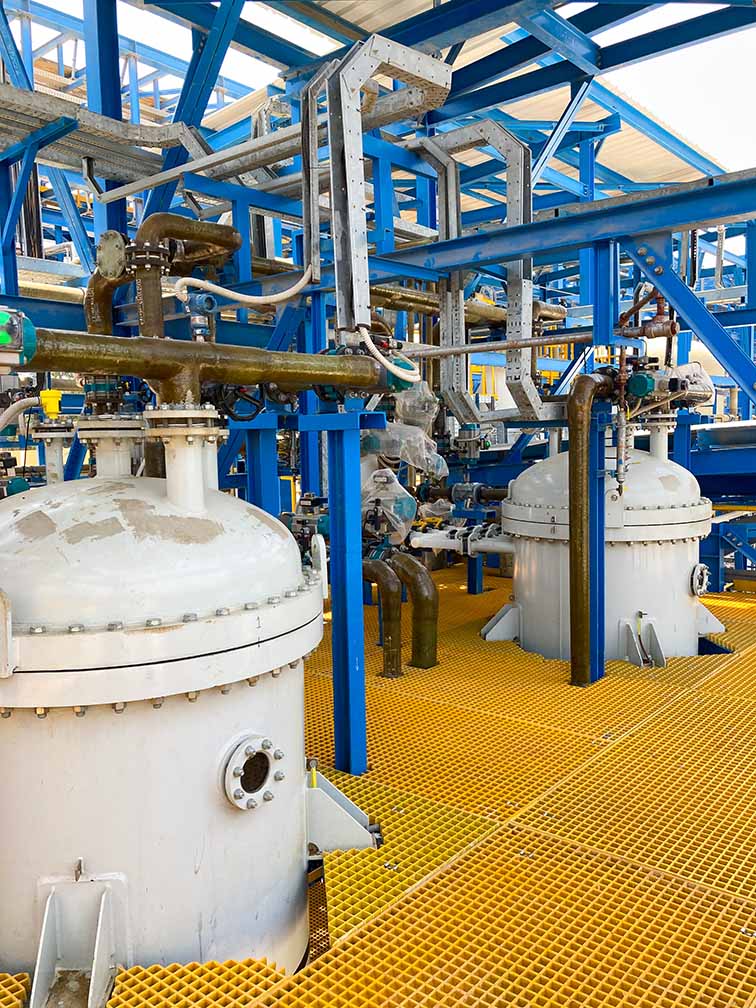
DrM, Dr. Mueller AG is a Swiss-based Company supplying sophisticated solid-liquid separation systems since 1982. DrM proprietary technology is installed in several thousands of plants worldwide and features candle type filter elements equipped with filter cloths and installed into a pressure vessel. The maximum operating pressure of the system is defined by the vessel design only, thus is virtually unlimited. Also, thanks to the absence of moving parts, the selection of materials of construction for both the vessel and the internal parts is not subject to any specific restriction imposed by temperature, pH or chemical compatibility whatsoever.
The inherent flexibility of the filter cloth and the peculiar design of the DrM candle element allow a thorough regeneration during the back-washing step and prevent the progressive blinding typically experienced with rigid elements, even when back-washed.
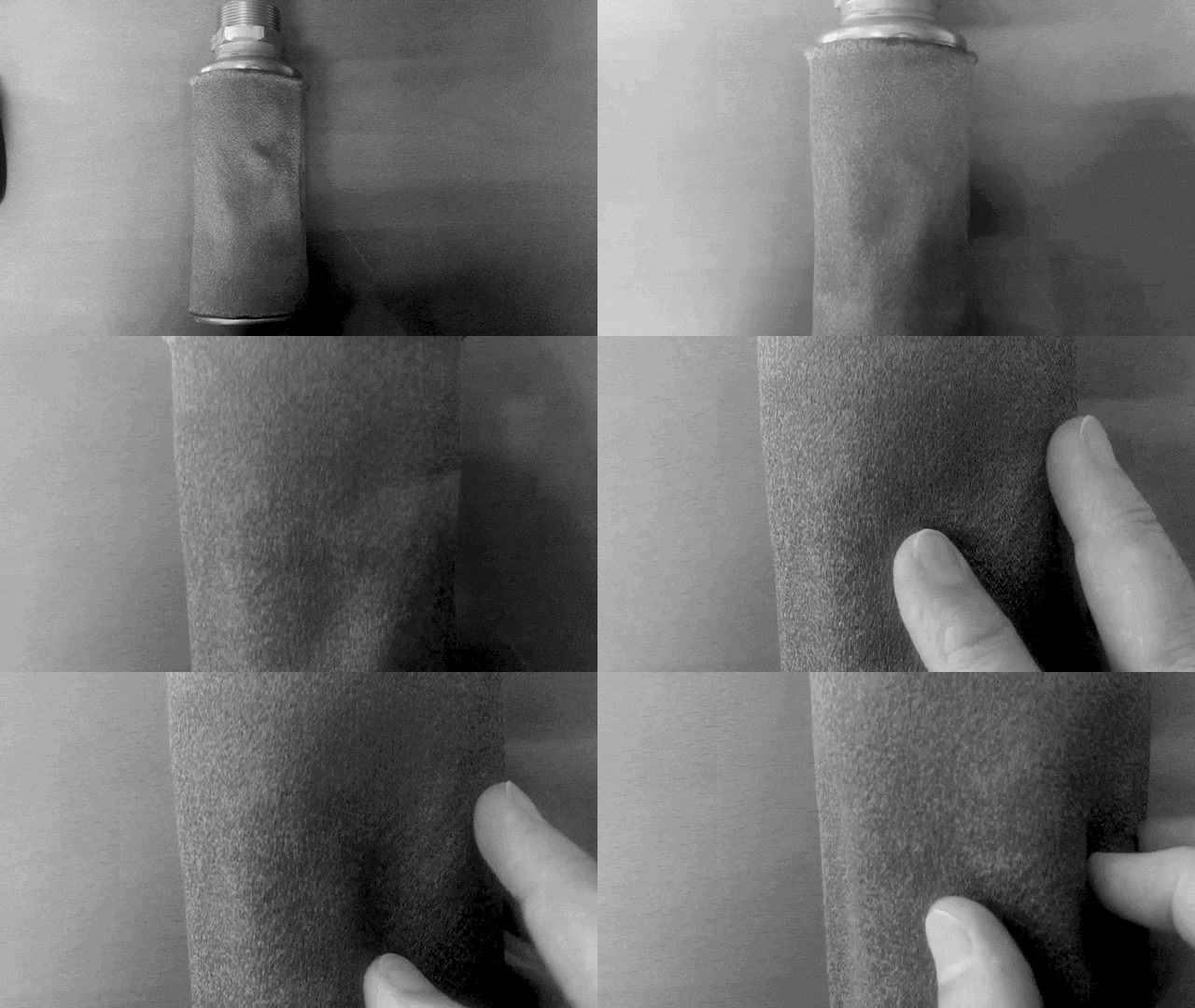
Filter cloths are normally fabrics themselves, and their thermal resistance sets the limit of applicability for the system as a whole. Since a few years DrM can offer filter cloths made with stainless steel filaments. This unique feature combines the flexibility of a fabric with an outstanding resistance up to 300°C continuous operating temperature.
Frequently Asked Questions
Why can’t mechanical recycling produce high-quality plastics?
Purely mechanical recycling crushes or shreds end-of-life objects and melts them into granules, but it cannot remove impurities that are chemically bound into the original structure, such as pigments, dyes or other substances used to colour or modify the object. Plastics recycled this way therefore have restricted use, limited to products of inferior quality.
How do advanced recycling processes achieve a cleaner grade of plastic?
To reach a cleaner grade comparable to petrochemically produced plastic, with the same wide range of applications, recycling must include a purification step. These more technology-intensive processes typically depolymerise the plastic into its constituent monomers or dissolve it in specific solvents. In dissolution methods the polymer (for example PP or PET) keeps its molecular structure while impurities remain in suspension and can be removed by solid-liquid separation.
Why is equipment selection so restricted in plastics purification?
Dissolution and depolymerisation are typically carried out under harsh conditions: high temperatures, high pressure, and chemically aggressive or hazardous solvents, sometimes in combination. This significantly restricts the choice of solid-liquid separation equipment to a few technologies. The ideal equipment is fully enclosed to keep the process media from contacting the environment, operates automatically without operator intervention, and is built from materials able to withstand the process conditions.
How fine are the impurities that must be removed?
Separation efficiency must be good enough to remove particles typically in the range of a few micrometres down to fractions of a micrometre. A common example is titanium dioxide, one of the most widely used pigments in the textile industry.
Why is the FUNDABAC® candle filter well suited to plastics recycling purification?
DrM’s candle-type filter elements are equipped with filter cloths and installed in a pressure vessel, so the maximum operating pressure is defined only by the vessel design and is virtually unlimited. With no moving parts, the choice of materials of construction for the vessel and internals is not restricted by temperature, pH or chemical compatibility, and the flexible filter cloth combined with the DrM candle element design allows thorough regeneration, making it well suited to this harsh, fully enclosed purification duty.