Hydrometallurgical leaching is one of the most chemically demanding mixing applications in process engineering. Extracting precious metals from ore, spent catalysts, or electronic waste requires precise, sustained agitation of a reactive slurry while protecting the chemistry from contamination. The mixing equipment used in these processes is rarely discussed as a critical variable, yet its design has a direct bearing on leaching efficiency, process integrity, and maintenance costs.
What makes agitation so critical in a leaching process?
Effective leaching depends on continuous, uniform contact between the solid feed material and the lixiviant solution. Without adequate agitation, solids settle, reactive surfaces become depleted, and metal recovery rates fall. Tanks in agitated leaching circuits are equipped with agitators specifically to keep solids in suspension and improve solid-to-liquid contact. The challenge is that achieving this uniformly across a vessel, without creating dead zones or disrupting the chemistry, requires a mixing profile that conventional rotating impeller designs often cannot reliably deliver.
Why do conventional rotating mixers create problems in leaching applications?
Rotating shaft mixers introduce several complications in leaching circuits. Mechanical seals and shaft bearings are exposed to abrasive slurries and corrosive lixiviants, creating wear points that require frequent maintenance and generate a contamination risk when they fail. Lubricants from bearing assemblies can leach into the process fluid, interfering with selective extraction chemistry. In applications where the lixiviant is a precisely formulated, mild reagent, any foreign input can reduce selectivity and recovery yield. Conventional baffled tank designs also create turbulence patterns that can be difficult to control uniformly at scale, particularly in vessels with non-standard geometry.
How does a vibromixer address the specific demands of metal leaching?
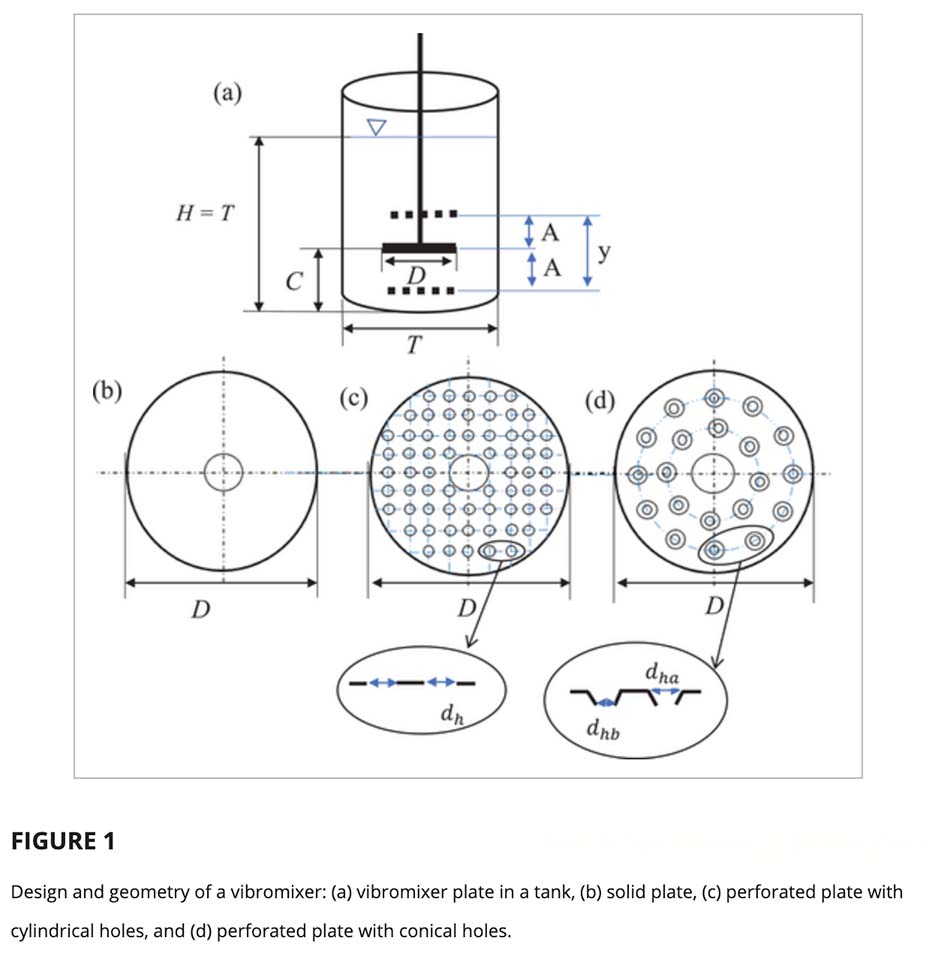
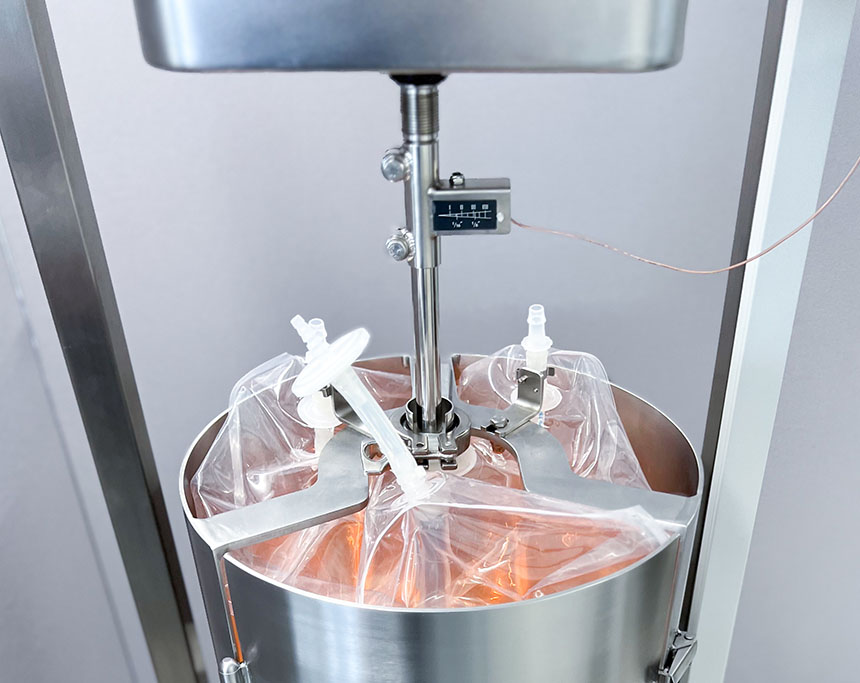
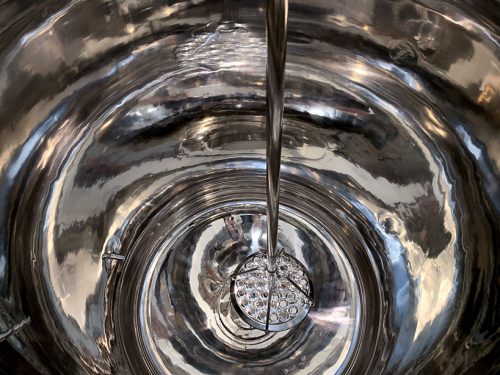
The FUNDAMIX® Vibro-Mixer generates mixing through high-frequency vibration from an electromagnetic drive, transmitted through a shaft to a perforated mixing plate with conical holes. The oscillating plate pumps liquid through the bores via the Bernoulli effect, producing an axial, vortex-free flow profile throughout the vessel. There are no rotating parts, no mechanical seals, and no lubricants required anywhere in the mixing assembly. The drive unit is separated from the process fluid by a pre-tensioned diaphragm sealing unit, which provides 100% containment at pressures from -1 to 5 bar g, with higher ratings available through alternative sealing configurations. For leaching applications involving reactive or precisely formulated chemistry, this design eliminates the contamination pathways associated with conventional agitators. The absence of rotating components also means there is no wear-driven particle generation from the mixer itself, which is particularly relevant when process purity affects downstream recovery steps.
What are the practical advantages for process designers and plant operators?
For a process engineer specifying mixing equipment for a leaching circuit, the FUNDAMIX® Vibro-Mixer offers several operationally relevant advantages. The system requires no baffles, which simplifies vessel design and cleaning. With no rotating parts subject to abrasive wear, maintenance intervals are significantly extended compared to conventional shaft-seal agitator configurations. Power consumption is low: the FM-3 model, suited to vessels from 50 to 1,000 liters, draws 200 W. The FM-4, covering 1,000 to 10,000 liters, draws 450 W. The operating temperature range of -4°C to 150°C covers the full range of atmospheric and moderately elevated temperature leaching conditions. For processes that require consistent, controllable mixing intensity without mechanical disruption of the slurry, the vibration amplitude and frequency can be adjusted to match specific retention time and solid suspension requirements.
How does vibromixer technology compare to a conventional agitator for leaching?
| Parameter | FUNDAMIX® Vibro-Mixer | Stirred tank (rotating impeller) |
|---|---|---|
| Rotating parts | None | Required |
| Mechanical seals | Diaphragm sealing unit | Rotating shaft seal |
| Lubricants | Not required | Required at bearings |
| Contamination risk | Minimal | Seal and lubricant exposure |
| Baffles required | No | Typically yes |
| Abrasive wear on mixer | Minimal | Impeller and seal wear |
| Power consumption (1,000 L) | 200 W | Varies; typically higher at equivalent scale |
| Operating pressure | -1 to 5 bar g (higher available) | Application-dependent |
| Operating temperature | -4°C to 150°C | Varies |
Source: Gimba, Poux & Aubin, Vibromixers as an Alternative to Stirred Tanks: Design, Performance Characteristics, and Applications. Chemical Engineering & Technology, 2026; 49:e70149. https://doi.org/10.1002/ceat.70149
What scale and configuration options are available for leaching applications?
FUNDAMIX® covers mixing volumes from 1 liter to 12,000 liters using the same vibration-based operating principle across the model range. Scaling a conventional stirred tank follows the power law P ∝ N³D⁵ (where N is rotational speed and D is impeller diameter), which means that, as the vessel size increases, maintaining the mixing performance requires either significantly higher drive power or a fundamental change to the mixing process. At standard operating conditions, the power per unit volume for a Rushton disc turbine is 5 to 17 times higher than that of an equivalent FUNDAMIX® (Gimba et al., 2026). The FUNDAMIX® avoids this drawback entirely through geometric scaling: while the plate scales proportionally with the vessel, the underlying design principle remains unchanged from the FM-1 at laboratory scale to the FM-4+ at full production volume. Lab-scale development and pilot work can be carried out with the FM-1 (1 to 10 liters), scaling directly to production vessels using the FM-3 through FM-4+ series. For leaching processes in corrosive or chemically aggressive environments, wetted parts can be specified in materials appropriate to the lixiviant chemistry. The system has been applied in metal leaching operations including precious metals recovery from secondary sources, where process chemistry integrity and equipment reliability are both primary design requirements.
Biological leaching represents an emerging and more sustainable pathway within hydrometallurgy, replacing conventional chemical lixiviants with microorganisms that selectively dissolve target metals. In this approach, bacteria are added to a reactor alongside the metal-bearing feed material, releasing biogenic compounds that extract gold or other precious metals at near-neutral pH. The FUNDAMIX® Vibro-Mixer is well suited to this class of application: its sealed, lubricant-free design protects the microbial environment from contamination, while gentle axial flow maintains the solid-liquid contact required for efficient bio-extraction without disrupting the organisms. Unlike conventional impellers, the FUNDAMIX® can reduce surface turbulence, helping to minimise foaming, which is a common challenge in biological processes involving bacterial cultures. The same technology is deeply established across both conventional hydrometallurgical leaching and biological processing industries. This makes the FUNDAMIX® a natural bridging solution for bioleaching, a discipline that is itself the intersection of these two fields. For process designers working at this interface, it offers a single, consistent mixing platform validated on both sides of the equation.
As the hydrometallurgy sector expands to include secondary source processing, from e-waste to spent catalysts to battery materials, the demands placed on mixing equipment are becoming more specific. Chemistry-first leaching processes, where selectivity and reagent efficiency determine the economics, need agitation systems that do not compromise the process environment. With its sealed, lubricant-free drive and controlled axial flow profile, the FUNDAMIX® Vibro-Mixer is suited to this class of application across both pilot and production scale.
Key takeaways
- Vibration-based mixing eliminates rotating parts, mechanical seals, and lubricants, removing contamination pathways in reactive leaching chemistry.
- The FUNDAMIX® Vibro-Mixer uses an electromagnetic drive and oscillating perforated plate to produce a controlled axial flow profile without baffles or rotating shafts.
- Operating parameters cover -4°C to 150°C and -1 to 5 bar g, with higher pressure options available for pressurized leaching conditions.
- The system scales from 1 liter to 12,000 liters using the same operating principle, supporting lab development through full production.
- Low power draw and the absence of wear-prone rotating components reduce both operating costs and maintenance requirements in leaching circuits.
Frequently Asked Questions
What is a vibromixer and how does it differ from a conventional agitator?
A vibromixer generates mixing through high-frequency vibration from an electromagnetic drive, transmitted through a shaft to a perforated plate with conical bores. Unlike a conventional rotating agitator, it has no rotating parts, no mechanical shaft seals, and requires no lubricants. The oscillating plate produces an axial, vortex-free flow profile throughout the vessel without the need for baffles.
Why is a vibromixer suitable for metal leaching applications?
Metal leaching processes use precisely formulated lixiviant solutions that are sensitive to contamination from lubricants or seal wear particles. A vibromixer eliminates these contamination pathways by design: the drive unit is separated from the process fluid by a pre-tensioned diaphragm sealing unit, with no rotating components in contact with the slurry. This makes it well suited to leaching circuits where process chemistry integrity directly affects metal recovery yield.
Can a vibromixer handle solid-liquid slurries in a leaching tank?
Yes. The oscillating plate generates an axial flow profile that keeps solids in suspension and maintains uniform solid-liquid contact throughout the vessel. The absence of rotating impeller components also means there is no wear-driven particle generation from the mixer itself, which is relevant for processes where particulate contamination affects downstream separation steps.
What vessel sizes and operating conditions does the FUNDAMIX® cover for leaching applications?
The FUNDAMIX® Vibro-Mixer scales from 1 litre to 40,000 litres using the same electromagnetic drive principle across the full model range. Operating conditions cover -4°C to 150°C and -1 to 5 bar g, with higher pressure ratings available through alternative sealing configurations. Wetted parts can be specified in materials appropriate to the lixiviant chemistry used in the leaching circuit.